
Clone Run
Hyperlab GamesAction
4.314.00 Reviews
- Version
- 1.0.2
- Installs
- 10.00K
- Age Rating
- Everyone 10+
Screenshots
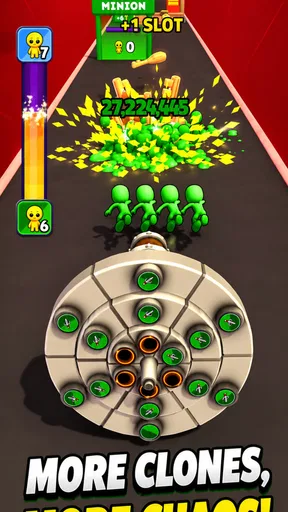
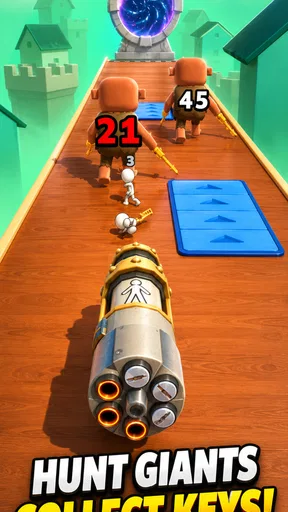
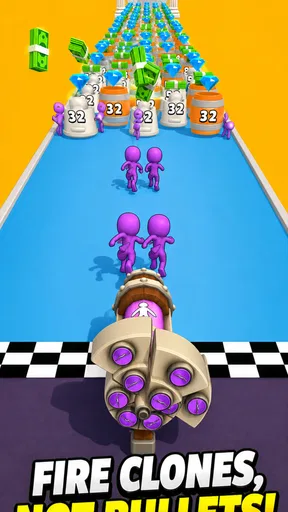
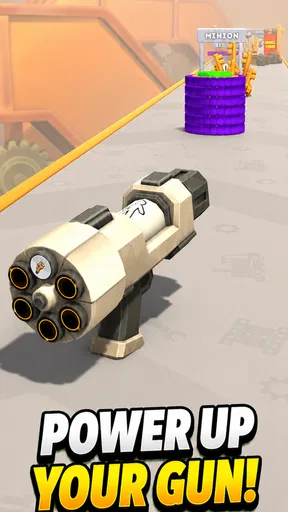
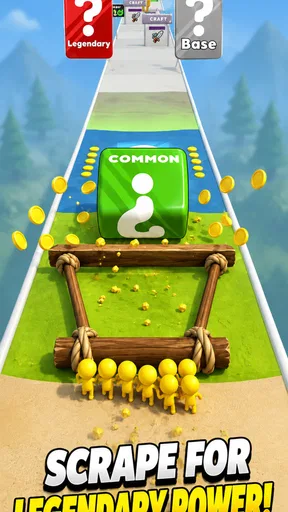
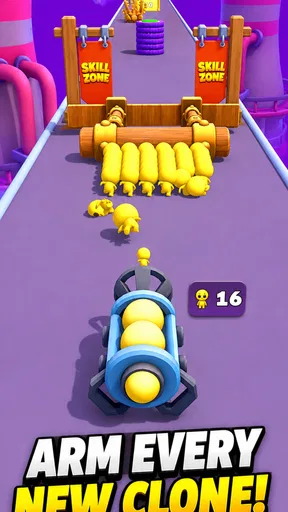
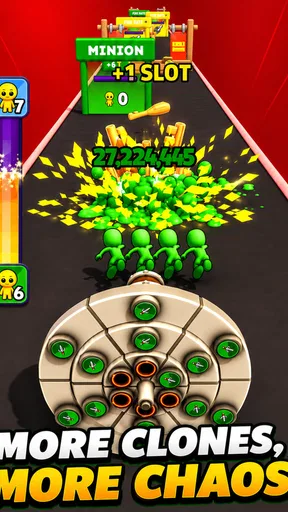
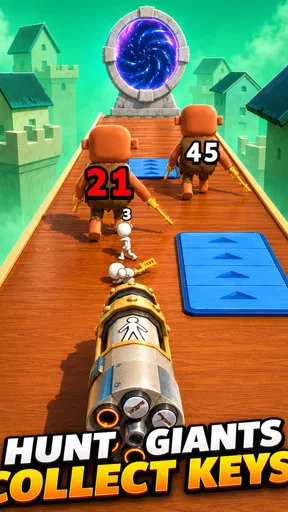
Our Review of Clone Run
 Analysis by Appyee
Clone Run is a free action game from Hyperlab Games that puts a simple question at the center of each attempt: how far can I run, how many clones can I fire, and how much stronger can I become as the world moves through different ages? I found the idea easy to understand almost immediately, which matters for a game designed around quick sessions. It does not ask me to learn a complicated story or manage a large menu before I can start playing.
What makes it interesting is the combination of movement, shooting, and growth. Running gives the game its forward pressure, while firing clones adds a more unusual tactical layer than I normally expect from a lightweight action title. The age progression also gives each run a sense of direction instead of making every attempt feel like the same short obstacle course. My overall impression is that this is best approached as a pick-up-and-play game: accessible in concept, lively in short bursts, and more demanding when I try to make careful choices rather than simply react.
How Clone Run feels to read, control, and play in different situations
I focus here on how the game’s quick, forward-moving action shapes the experience in different settings, from a quiet break to a distracting commute. I also consider how the clone mechanic changes the decisions I make while running, so the next section can look at what that means in practice rather than treating it as a simple extra button.
Clear presentation helps me understand the basic loop
The strongest accessibility quality here is conceptual clarity. The store summary describes the experience in a few direct actions, and that matches the way I approached it: move forward, use clones, and build strength. I did not need to decode a dense role-playing system to understand what I was trying to accomplish. That makes it a comfortable starting point for someone who usually avoids action games because they seem overloaded with instructions.
The game’s short name and brief store description also set the right expectation. This is not presented as a slow strategy experience or a narrative adventure. It is an action game built around momentum. For me, that made the first sessions feel approachable because I knew to expect active play rather than long reading sections. Someone who prefers to understand every rule before touching the controls may still want a little time to learn through play, but the central idea is not difficult to grasp.
Its current version, 1.0.2, is compatible with Android 7.0 and later. That gives it a reasonably broad technical starting point for Android users, although compatibility alone does not tell me how comfortable the game will feel on every screen size or device. A smaller display may make fast action harder to follow, while a larger phone or tablet can give the play area more breathing room.
I also appreciate that the age guidance is Everyone 10+. That places the game in a space where younger players and families can consider it, while still recognizing that action, combat, or fast reactions may not suit every child. I would still judge the experience by the individual player’s comfort with visual movement and repeated attempts rather than treating the age label as a guarantee that it will work equally well for everyone.
Readability matters more when the screen is busy
In a game based on running and firing, the most important information has to be understood quickly. I found the basic goal easy to keep in mind, but action games can become less readable when several moving elements compete for attention. The practical test is not whether I can understand the screen while standing still; it is whether I can recognize danger, choose a direction, and decide when to use a clone while the run is already moving.
That makes the game more suitable for players who can comfortably track animation and changing positions. If bright movement, crowded scenes, or rapid visual transitions cause fatigue, I would approach it in shorter sessions and avoid playing when tired. The game’s straightforward premise helps, but it cannot remove the sensory demand created by constant action.
One useful habit is to spend the first few attempts learning the visual language rather than trying to set a personal best. I paid attention to which objects represented threats, opportunities, or progression cues. That reduced the mental load later because I was no longer trying to interpret every item from scratch. This is a small but meaningful advantage: the game rewards observation before speed, even though the action itself remains fast.
I would also recommend checking the game on the device that will actually be used most often. A title that feels readable on a bright, large display may be more tiring on an older phone with a smaller screen. That is not a flaw unique to this game, but Clone Run’s forward motion makes the difference more noticeable than it would be in a turn-based title.
Motor demands are simple in theory but active in practice
The control idea is easier to approach than a game with several virtual buttons, inventory panels, and character abilities. Running and firing clones form a compact interaction model, so I did not feel buried under controls. That simplicity can help players who find complex control layouts difficult to remember.
However, fewer actions do not automatically mean low physical demand. Timing still matters. I had to respond while the character continued moving, and that creates pressure for anyone who has limited dexterity, slower reaction speed, hand discomfort, or difficulty making repeated taps. A player may understand exactly what should happen and still struggle to execute it before the opportunity passes.
For that reason, I see Clone Run as more forgiving for cognitive simplicity than for motor precision. The game is easy to explain, but not necessarily easy to perform. Someone with limited hand mobility may prefer an action game with adjustable controls, slower pacing, or turn-based decisions. Clone Run is a better fit when the player enjoys quick responses and can comfortably repeat a movement or firing action for the length of a run.
My most useful control tip is to avoid treating every moment as an emergency. I initially reacted to everything immediately, which made my play feel rushed. Once I started watching the path for a moment before firing, I made more deliberate choices and wasted fewer opportunities. That approach does not remove the need for speed, but it turns the game from pure panic into a rhythm of movement, recognition, and action.
Clone decisions add a layer beyond ordinary running
The clone mechanic is the part that gives this game its own identity. In a conventional endless runner, the central question is often whether I can dodge the next obstacle. Here, I also have to think about when creating or firing clones is worth doing. That decision gives the action a small strategic edge without turning it into a complicated management game.
I found it helpful to think of clones as a resource for changing the shape of a difficult moment, not simply as an action to press whenever available. Using them immediately may feel satisfying, but saving the opportunity for a crowded section can produce a better result. The right choice depends on what is happening in the run, so the mechanic encourages attention rather than automatic tapping.
This is also where the game becomes less interchangeable with a standard runner. If a player only wants lane changes and instant reactions, the clone system may feel like extra work. If the player likes making small tactical choices while moving, it gives each attempt more texture. It is not a deep strategy system, but it is enough to make me reconsider how I approach the next stretch.
Growing through the ages gives failed runs a purpose
The progression through different ages is another useful design choice. It gives the run a broader sense of advancement and makes improvement feel connected to more than distance. I enjoyed the feeling that a run was part of a larger journey, even when I did not reach as far as I wanted.
That structure can be motivating for players who need a visible reason to try again. Instead of viewing failure as a complete reset, I could treat it as information about how to handle the next attempt. The growth theme also complements the clone mechanic: I am not only surviving the present moment, but working toward a stronger future version of the run.
There is a trade-off, though. Players who prefer a fixed challenge with a clean finish may find repeated progression less satisfying than a traditional level-based action game. Clone Run is built around returning to the loop, learning its demands, and trying again. If repetition feels boring after a few attempts, the age-based growth may not be enough to hold attention.
Everyday use: a short break without a large commitment
I think the clearest use case is a spare five or ten minutes while waiting for an appointment, commuting as a passenger, or taking a break between tasks. The premise is immediate, and I do not need to remember a complicated plot when I come back later. That makes it easier to fit into an irregular day than a long-form action game that expects uninterrupted attention.
For example, I could play a few attempts during a lunch break, use the first one to settle into the controls, and spend the next attempts experimenting with when to fire clones. If I had only a moment, I could still start a run without feeling that I was abandoning a large mission halfway through. That flexibility is one of the game’s practical strengths.
It is less suitable when I need to divide my attention. Playing while walking, crossing a street, supervising a child, or handling another task would be a poor choice because the action depends on noticing what is ahead. Even a simple game can become inaccessible when the environment is distracting. Clone Run works best when I can look at the screen continuously for a short, focused period.
Where the experience may create friction
The main barrier is the tension between a simple concept and fast execution. A player can understand the objective but still find the pace exhausting. Repeated failures may also feel discouraging if the game does not match the player’s reaction speed or tolerance for trial and error.
Another consideration is the free-to-play structure. Clone Run costs nothing to start, but it includes in-app purchases ranging from $0.99 to $24.99 per item. I would keep that in mind before handing the device to a child. The presence of purchases does not by itself tell me how necessary they are, but it does mean I would use the platform’s purchase protections and make sure the player understands that optional spending may be available.
Players looking for a quiet, low-stimulation experience should probably skip this one. The running format naturally asks for attention, and the action focus may be tiring for people who prefer calm puzzles, reading, or turn-based play. Likewise, anyone expecting a large story, deep character customization, or a long campaign may be happier with a more substantial action role-playing game.
On the other hand, someone who finds large games overwhelming may appreciate the compact design. The game does not require me to learn a huge collection of systems before I can enjoy the central loop. That makes it a reasonable bridge for a player who wants action but is not ready for a complex console-style experience.
How it compares with familiar action alternatives
Compared with a conventional endless runner, Clone Run feels more deliberate because the clone mechanic gives me another choice besides dodging. It still benefits from the immediacy of the runner format, but it asks me to consider timing and growth as well as survival. I would choose it over a basic runner when I want a little more decision-making in each attempt.
Compared with a twin-stick shooter or a larger action game, it is much easier to approach. There are fewer systems competing for attention, and the age progression gives the experience a clear direction. The compromise is depth: players who want elaborate loadouts, carefully tuned builds, or extensive missions may find this too compact.
It also differs from a turn-based action game in an important way. Turn-based alternatives give me time to plan every move, while Clone Run asks me to combine planning with reaction. That makes it more exciting for quick-play fans, but less comfortable for players who need unlimited time to process the screen. Choosing between the two depends less on genre loyalty than on how the player likes to make decisions.
Practical expectations before downloading
The game is free to download, and its average rating is 4.3 from over 500 ratings, with 14 written reviews. I read that as a positive early signal rather than a final verdict. The install count is over 10 thousand, so the game has attracted an initial audience, but it is still the kind of title I would judge personally after several sessions because action games can suit one player and frustrate another.
Hyperlab Games has kept the store identity concise, which matches the product’s quick-entry character. I would not install it expecting a long tutorial or a detailed explanation of every possible situation. Instead, I would give myself a few runs to learn how movement, clone firing, and age progression fit together. That learning period is part of the experience, but it may bother anyone who wants exhaustive instructions before making a mistake.
If you are deciding whether it will work for a child, I would consider three things: comfort with rapid visual action, ability to make repeated touch inputs, and understanding of in-app purchases. The Everyone 10+ rating makes it a plausible family option, but the actual fit depends on those practical details. For an adult with limited time, the short-session structure is more persuasive than the rating or the install count.
My inclusive verdict
Clone Run is easiest to recommend to players who want a clear action loop with a small tactical decision built into it. I like that I can understand the objective quickly, start playing without a large commitment, and still find reasons to adjust my approach. Firing clones is more interesting than a purely automatic runner, while growing through the ages gives repeated attempts a sense of continuity.
Its accessibility is strongest at the level of ideas and onboarding. The game is compact, direct, and less intimidating than a large action title. Its weaker side is physical and sensory: fast movement, visual tracking, and repeated reactions can make it demanding for players with motor limitations, attention challenges, or sensitivity to busy action. I would not describe it as universally comfortable, but I would describe it as easy to understand and worth testing in short sessions.
I would choose it for a quick break, a younger player who enjoys action and can manage touch controls, or anyone who wants a runner with more to think about than simple dodging. I would skip it in favor of a slower or turn-based alternative if reaction speed, visual calm, or detailed planning is the priority. For the right player, the free entry point makes that experiment easy, and the clone-and-growth combination gives the game enough personality to stand apart from the usual running formula.
Verdict
Strengths of Clone Run
- Simple controls make it easy to start playing immediately.
- Short runs are convenient for quick gaming sessions.
- Bright visuals make the action easy to follow.
- Multiple clones create satisfying crowd-building moments.
- The game works well for casual, pick-up-and-play entertainment.
Limitations of Clone Run
- Gameplay can become repetitive after extended sessions.
- Frequent ads may interrupt the experience between runs.
- Progression may feel limited for players seeking deeper challenges.
- Some levels offer little variation in objectives or strategy.
- Performance may vary on older or less powerful devices.
Similar Picks in This Category
View All
Temple Run 2: Endless Escape
Imangi Studios4.1

PUBG MOBILE
Level Infinite4.3

Free Fire: 9th Anniversary
GARENA INTERNATIONAL I4.4

Talking Tom: Hero Dash Run
Outfit7 Limited4.3

slither.io
Lowtech Studios3.9

Sniper 3D:Gun Shooting Games
Wildlife Studios4.6
Frequently Asked Questions
What is Clone Run, and how does the game work?
Clone Run is a fast-paced mobile running game focused on collecting and multiplying a group of characters while moving through obstacle-filled stages. As you run, you typically choose gates, gather bonuses, avoid hazards, and try to finish with the largest possible crowd. The controls are designed to be simple, usually relying on swipes or taps, although timing and route selection become more important as the levels get harder.
Is Clone Run free to download and play?
Clone Run can generally be downloaded and played without an upfront purchase, making it accessible to most Android and iOS users. However, free-to-play games may include advertising, optional in-app purchases, or both. These extras can sometimes provide cosmetic items, bonuses, or convenience features. Before downloading, it is worth checking the store listing for the current pricing details and reviewing your device’s purchase restrictions if children may use the app.
Does Clone Run require an internet connection?
The basic running levels in Clone Run may be playable without a constant internet connection, which is useful when traveling or when mobile data is limited. Nevertheless, some features can depend on connectivity, including advertisements, rewards, updates, leaderboards, cloud-related services, or in-app purchases. Offline availability can also vary between versions, so users should test the game after installation rather than assuming every feature will work without internet access.
Is Clone Run suitable for children and younger players?
Clone Run is generally easy to understand because its gameplay is based on straightforward movement, collecting characters, and avoiding obstacles. That simplicity can make it appealing to younger players, but parents should still review the official age rating and privacy information. Advertising and optional purchases may be present, and some ads could be unsuitable for every child. Using parental controls and disabling unauthorized purchases is recommended for family devices.
What should I know about Clone Run’s performance and advertisements?
Clone Run is designed for quick sessions, but performance can depend on the age and specifications of your phone or tablet. Older devices may experience slower loading, reduced responsiveness, or occasional crashes, especially after extended play. Like many free casual games, it may also display advertisements between rounds or after claiming rewards. Keeping the app updated, closing unnecessary background apps, and using a stable connection can help provide a smoother experience.
Play our best games!


